Originating in Morocco, argan oil has become one of the most iconic ingredients in Moroccan beauty over the years. Nourishing and versatile, it can be used on the face and body as well as on the hair and nails.
Recently, argan oil took center stage in an episode of Conan O’Brien Must Go, in which the American host explores it in Morocco. It is a great opportunity to revisit this essential ingredient: where does argan oil come from? What are its benefits? How should it be used, and how can you recognize high-quality oil?
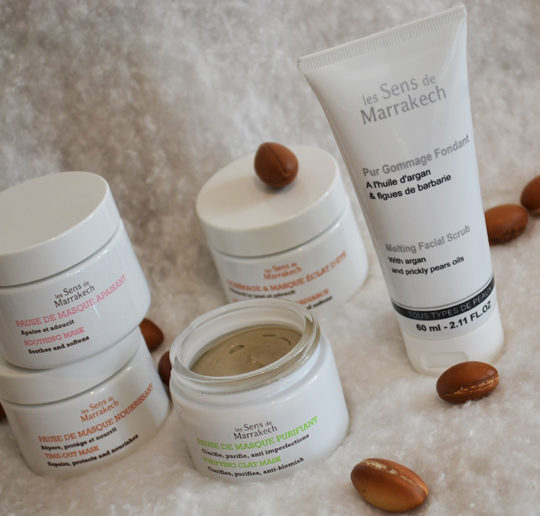
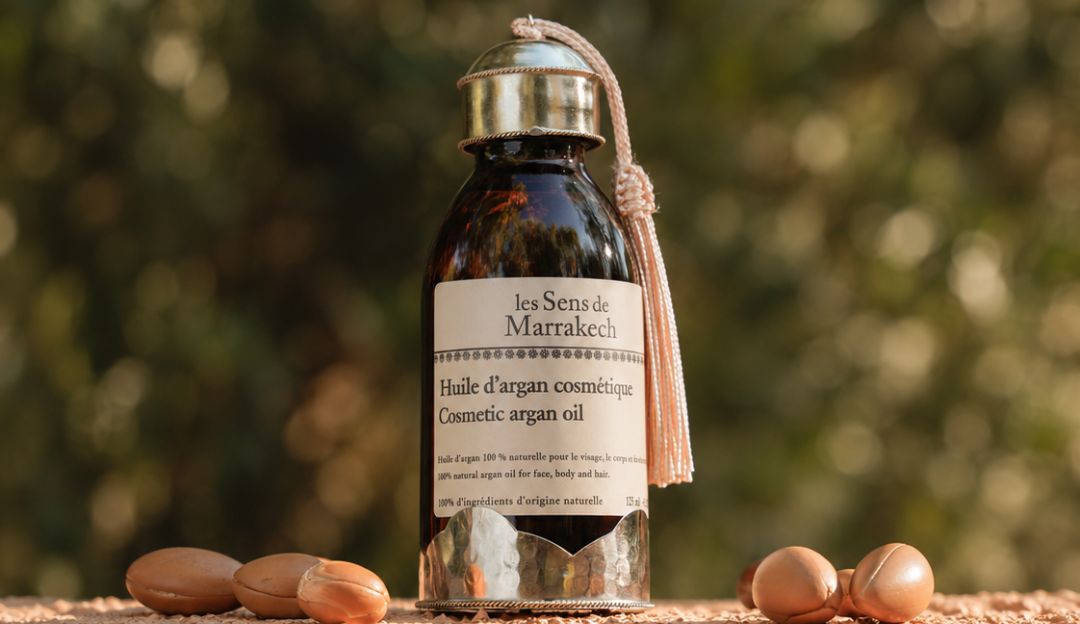
Deeply inspired by Moroccan beauty rituals, Les Sens de Marrakech naturally gives argan oil a special place in its creations and also offers a pure, 100% natural argan oil sourced from Morocco.
What is argan oil?
Argan oil is extracted from the kernels found in the fruit of the argan tree, which grows primarily in southwestern Morocco. After harvesting, the fruit is dried, shelled, and pressed to produce this naturally golden-colored oil.
There are two main categories of argan oil. Culinary argan oil is made from lightly roasted kernels, giving it a distinctive flavor reminiscent of hazelnuts. Cosmetic argan oil, on the other hand, is intended for use on the face, body, nails, and hair.
What are the benefits of argan oil for the skin?
Naturally rich in fatty acids and vitamin E, argan oil is highly prized for its nourishing properties. It helps maintain skin suppleness and provides a feeling of comfort, particularly for dry skin. It also helps support the hydrolipidic film—the natural barrier that protects the skin and prevents dehydration. With regular use, it leaves the skin feeling softer, more supple, and well-nourished.
Argan oil can be applied after showering, while the skin is still slightly damp. Just a few drops are enough to treat dry areas such as hands, elbows, knees, or feet.
Can argan oil be used on the face?
Yes, argan oil can be incorporated into your facial skincare routine. After cleansing your skin, place two or three drops in the palm of your hand and warm them slightly before applying with gentle motions.
It can be used on its own or mixed with a moisturizer. Thanks to its nourishing texture, it is particularly pleasant to use in the evening.
As with any new skincare product, it is advisable to start with a small amount and perform a patch test on a limited area of skin before regular use.
How do you use argan oil on hair?
Argan oil is particularly well-suited for hair that is dry, dull, curly, or damaged by heat styling tools and chemical treatments. It nourishes the lengths, softens the hair, and adds shine. It can be used in several ways:
- as a pre-shampoo oil treatment;
- to boost a hair mask;
- on the lengths and dry ends;
- after styling, for a touch of shine.
For an oil treatment, apply a small amount to the lengths and ends, then let it sit before shampooing. For fine hair, one or two drops are enough to avoid weighing the hair down.
Can argan oil be used on nails?
Argan oil can also be used to care for hands, nails, and cuticles. Simply apply a drop to each nail and gently massage the surrounding area.
This nourishes dry cuticles and leaves hands feeling softer. You can do this in the evening before bed to take the time to enjoy this little self-care ritual.
How do you recognize high-quality argan oil?
When choosing cosmetic argan oil, it is important to consider its composition, origin, and quality. Pure argan oil should be 100% natural, with no added fragrance, coloring, or other oils.
Its color can naturally range from pale yellow to golden, and it has a subtle scent. Like all vegetable oils, it is best stored away from light and heat.
The argan oil offered by Les Sens de Marrakech is 100% natural, sourced from Morocco, and comes in a glass bottle.
How should argan oil be stored?
Argan oil should be stored in a dry place, away from light and significant temperature fluctuations. It is also important to tightly close the bottle after each use to minimize exposure to air.
Generally, refrigeration is not necessary. Storing it in a cupboard at room temperature is sufficient to preserve its quality.
Is argan oil suitable for all skin types?
Argan oil can be suitable for many skin types, though individual reactions to cosmetic products may vary. It is therefore recommended to perform a patch test on the inside of the elbow and wait 24 to 48 hours before applying it more extensively.
Those with oily or blemish-prone skin might start by applying just one or two drops to specific areas. In the event of a reaction or any specific dermatological issue, it is best to consult a healthcare professional.
Is it better to use pure argan oil or products containing argan oil?
The choice depends on your needs and how you wish to use it. Pure argan oil is particularly well-suited for targeted care—such as for dry hair ends, cuticles, hands, or areas of the body prone to dryness. A few drops are usually enough.
Products formulated with argan oil—such as creams, body lotions, or hair care products—combine this ingredient with other components. Their textures and applications may be more convenient for certain steps in your daily routine.
There is no need to choose between the two. Pure argan oil allows for a personalized skincare step, while products enriched with argan oil let you incorporate the ingredient into various beauty rituals. Far more than just a cosmetic ingredient, argan oil is an integral part of Moroccan heritage and beauty rituals. A few drops are all it takes to nourish the skin, care for the hair, or soften hands and cuticles.
Through its pure argan oil and treatments inspired by Moroccan traditions, Les Sens de Marrakech keeps this ancestral ritual alive in its own unique way, inviting you to easily incorporate it into your daily routine.